Please ensure Javascript is enabled for purposes of website accessibility

Category: Health and Wellness

  • What can physical therapists do to address your postpartum dizziness?

    What can physical therapists do to address your postpartum dizziness?

    Getting back on your feet after you’ve just had a baby is no easy feat. You’re in the process of getting to know your new baby, operating on a lack of sleep and trying to understand all the changes your body is still going through. The newborn period is both magical and hard. 

    Postpartum conditions

    Life after a baby is born is the most beautiful time. It can, however, also be incredibly challenging. You’re trying to recover from a major medical event and also bond with your baby, and you’re likely running on very little sleep. While being a new mom can feel incredibly lonely, you are not alone. Help is available to you.

    During your postpartum period, you may experience symptoms that include:

    A physical therapist can help you recover from pregnancy and childbirth, increasing your pelvic health and reducing your postpartum dizziness.

    About postpartum dizziness

    It’s common to hear about diastasis recti and organ prolapse after pregnancy, but postpartum dizziness is also a fairly common, but less talked about condition. Experiencing dizziness and loss of balance can be a challenge — especially when you’re postpartum. 

    First of all, if you’re experiencing dizziness and you’re less than six weeks past delivering your child, you should call your physician immediately. Some forms of dizziness may be signs of preeclampsia, which can occur even after a baby is born.

    Once your physician has ruled out that your dizziness is not related to a serious postpartum complication, a physical therapist may be able to help you find relief. Your specialist will perform a postpartum evaluation on you, which includes: 

    • Understanding your medical history before, during and after pregnancy.
    • Assessing your posture, checking for pelvic alignment, and evaluating strength and mobility in your body.
    • Evaluating you for diastasis recti.
    • Examining your breathing patterns. 

    Postpartum dizziness can be caused by vertigo, which can be treated by physical therapy. If you’re feeling postpartum dizziness, our physical therapists at Whatcom Physical Therapy can help. Contact our team today for more information or to schedule an initial appointment.

  • What is involved in an annual wellness exam at a physical therapy clinic?

    What is involved in an annual wellness exam at a physical therapy clinic?

    For nearly two years now, health and wellness have been serious concerns for many Americans. It’s not too surprising then that a 2020 survey found that 57% of Americans claimed that they were prioritizing their health and wellness even over financial concerns. 

    One way to take a first step toward improving your wellness is to have an annual physical therapy exam. However, many people who read this might be wondering why they should turn to a physical therapist for an annual wellness exam. They might also be curious about what is involved in such an exam. Let’s answer these questions for you. 

    Why turn to a physical therapist for an annual wellness exam?

    Most people would probably think they need to go to their doctor for an annual wellness exam. They don’t even consider going to a physical therapist for such a checkup. However, getting a yearly checkup from a physical therapist can be helpful for several reasons. 

    For one thing, physical therapists focus on different things than your primary care doctor would. They can take a closer look at the health and wellness of the bones, muscles and other structures that make up your musculoskeletal system. That can be helpful since it is this system that allows you to perform every movement and activity you do every day. 

    What is involved in an annual wellness exam from a physical therapist? 

    What is included in an annual wellness exam performed by a physical therapist can vary. Each person is different, after all. They may also be dealing with different musculoskeletal issues. However, there are several general steps that are typically included in the annual wellness exam your physical therapist will perform. Some of these include: 

    1. A joint mobility check — Determining how mobile your joints are is a vital part of an annual wellness assessment. Why? Your joints are the sites where many of the movements you do every day take place. 

    Pain in your knees when walking up and down the stairs. Difficulty opening doors. Trouble grasping cups or phones. These are just a few of the consequences of poor joint mobility. Your physical therapist can measure your joints’ mobility and range of motion (ROM). They can then take steps to help you if your joint mobility is poor.  

    1. A spinal mobility check — A mobile spine is necessary for all the bending and twisting movements you do daily — often, without thinking much about them. Physical therapists can assess your spinal mobility during your annual wellness exam. This typically involves your therapist asking you to move your spine in various ways and recording any difficulties you have. The information can then be used both for tracking your future mobility and as the basis for a physical therapy plan to improve your spinal mobility. 
    1. A muscle strength and flexibility check — Your joints and spine both require help from soft tissue to move. Your muscles are the most important of these soft tissue structures. However, they can often become weak or stiff in their own right. Your physical therapist can determine your muscle strength and flexibility levels during your annual wellness exam. They can also make recommendations about how to improve them. 

    Have a beneficial annual wellness exam at Rehab Access

    Keen to learn more about what an annual wellness exam is able to do for you? Our Rehab Access Physical Therapy clinicians are eager to help you. Our physical therapists are well versed in the human musculoskeletal system and its disorders. This knowledge allows them to assess various parts of your body effectively either when you’re in pain or as part of an annual wellness checkup. 

    Contact our team today for more information about how we can help improve your health and wellness or to schedule an initial appointment with us.

  • How can physical therapists help with workplace injury prevention?

    How can physical therapists help with workplace injury prevention?

    Did you know that there are over 2.9 million workplace injuries in the U.S. each year? Nobody wants to injure themselves at work, which can put many people in a difficult position when they depend on their job. But if you’re wondering how to prevent an injury at the workplace, then you’re making a proactive decision for your health and well-being. So what steps can you take with workplace injury prevention? 

    Here’s how a physical therapist can help you prevent an injury at the workplace.

    How physical therapy can help with workplace injury prevention

    Depending on what kind of job you work, there can be myriad hazards to watch out for. It may not even be something inherently dangerous: Just lifting something the wrong way can lead to a painful back injury! But being informed by a physical therapist can help you be safer at work. Here are some ways physical therapists can help you prevent an injury while on the job:

    • Demonstrating specialized therapeutic exercises that can strengthen the muscle groups used at work while reducing tension in any strained joints.
    • Educating you in the most effective stretching techniques to perform before work to help loosen the muscles so they remain flexible throughout the day. 
    • Performing a thorough physical evaluation to ascertain any ongoing musculoskeletal issues that may eventually lead to an injury. 

    What if I already injured myself?

    If you have already injured yourself in the past but are concerned about re-injuring the same area, physical therapy can still help. Physical therapists can build you a personalized work hardening program that simulates your normal work environment. In this controlled space, you may be asked to perform similar actions that you might while on the job. With professional oversight, you can help build your body up in a controlled way that negates the risk for injury. It also provides an opportunity for a physical therapist to evaluate your posture. Proper form is important for reducing strain on the body while at work. 

    Worried about injuring yourself at work? Panther PT is ready to help you with workplace injury prevention

    Hurting yourself at work can be difficult. It’s best to be proactive and try to prevent an injury in the first place. That’s where we come in. Our team at Panther Physical Therapy has years of experience with workers just like you. We are prepared to build you a personalized treatment plan that helps prevent workplace injuries. 

    Contact our team today for more information about workplace injury prevention or to schedule an initial appointment.

  • Why would my physical therapist have me do the kneeling hip flexor stretch?

    Why would my physical therapist have me do the kneeling hip flexor stretch?

    It is not always a bad thing to question the treatments that medical professionals prescribe for you. Doing so shows that you are engaged in your treatment. Also, asking questions is an excellent way to learn more about the methods being used to treat you. Asking yourself, “Why is my physical therapist having me do the kneeling hip flexor stretch?”? Read on to find out some possible answers that physical therapists often give for this question. 

    Three reasons your physical therapist is having you do the kneeling hip flexor stretch:

    1. You have a hip flexor injury — The most likely answer to your question is that you have a hip flexor injury, such as a strain. Your hip flexors are a group of muscles that are found at the front of your hips. Their job is to help move your thigh and knee closer to your body. These muscles can be injured anytime you change direction suddenly or if your hip flexors are weak or tight. Physical therapists often prescribe the kneeling hip flexor stretch to help keep the injured hip flexor supple and help keep it free of scar tissue. 
    1. You sit a lot — Medical studies show that Americans are sitting down for a significant portion of their day. One study found that nearly 26% of adults sit for more than eight hours per day. Sitting for prolonged periods can lead to many issues, including tight hip flexors. If you sit for long periods, your physical therapists may ask you to try the kneeling hip flexor stretch to improve your flexibility. 
    1. You have certain types of pain — Tight hip flexor muscles can be a root or contributing cause to many types of pain. Some of these include: 

    Doing certain therapeutic stretching exercises can help ease these types of pain. 

    How can I perform the kneeling hip flexor stretch? 

    Your physical therapist can show you how to perform this stretch properly. The procedure for this stretch often involves: 

    • Kneeling down on your right knee with your left leg bent so that your foot is flat on the floor. 
    • Engaging your core muscles to help keep your torso upright. 
    • Slowly leaning forward until you feel a stretch where your right hip and thigh join. 
    • Holding this stretch for 20 to 30 seconds. 
    • Switching legs to stretch your other side. 

    Find help for your pain that goes beyond stretches at SOL PT

    Stretches like the kneeling hip flexor stretch are hardly the only way to treat hip flexor-related pain. At SOL Physical Therapy, our physical therapists can bring many treatment techniques to bear on your pain. The personalized therapy plan we build for you may include: 

    Contact our team today for more information about how we can help with your pain or to schedule your initial appointment with us. 

  • How to relieve a stiff neck without taking medication

    How to relieve a stiff neck without taking medication

    Dealing with a stiff neck can put a damper on your life. Many of us spend time looking at screens like the phone and the computer, which can contribute to chronic neck stiffness. There can also be many other different causes behind a stiff neck, like labor-intensive jobs or an injury. Regardless of the underlying condition, neck discomfort shouldn’t be ignored. Medication can take your symptoms away. But physical therapy offers an effective natural way to alleviate neck stiffness. It can even reduce your pain.

    Are you wondering how to relieve a stiff neck? Physical therapy can provide a safe and natural way to loosen up your neck muscles and get you back to normal again.

    How physical therapy can help relieve your stiff neck

    Your physical therapist will recommend a treatment plan based on the severity of your neck stiffness. The treatment plan will be designed to address your individual needs including areas of discomfort or pain. Your physical therapist will evaluate your neck. This is to determine the most effective ways to treat the underlying condition behind your stiffness. Unlike medication, which just treats the symptoms of a stiff neck, physical therapy is intended to target the cause.

    Here are some common techniques used in physical therapy that target the cause of neck stiffness:

    • Ergonomic adjustments — Your sitting and standing posture can impact the stiffness of your neck. Your physical therapist may evaluate your posture. This allows them to determine the appropriate adjustments you can take to relieve neck tension. Proper posture can take the pressure off your neck and help relieve a stiff neck.
    • Therapeutic exercises — Your physical therapist can educate you in the most effective therapeutic exercises for strengthening your neck muscles. Low-impact exercise can stimulate your neck, which provides a relief in neck tension. This can also help improve your posture.
    • Soft tissue mobilization — This technique is a form of manual therapy. It’s a hands-on technique that can stimulate blood flow to the soft tissue and can relieve neck stiffness. 

    Panther Physical Therapy is prepared to help relieve your stiff neck

    If you’re tired of living with neck stiffness, our expert team at Panther Physical Therapy can help you find relief. We are prepared to build you a personalized treatment plan to relieve your stiff neck. This can help reduce your neck stiffness, strengthen your neck muscles and improve your posture. 

    Contact our team today for more information about how we can help treat your neck stiffness or to schedule an initial appointment.

  • Three benefits of doing exercise classes with a physical therapist

    Three benefits of doing exercise classes with a physical therapist

    It’s hardly a secret that exercise can benefit people, and each type of exercise can offer different health benefits. 

    For instance, strengthening exercises can help build up your muscles. They can also promote better blood flow in your muscle tissue. Cardiovascular exercises can help improve your heart health and improve blood oxygen levels. Unfortunately, only about 21% of Americans exercise every day to gain these advantages. 

    One way to get in some more physical activity is to take an exercise class with a physical therapist. Doing so can offer benefits that go beyond those of exercising on your own. 

    Going to exercise classes taught by physical therapists can offer these three benefits: 

    1. Better musculoskeletal system understanding — Physical therapists are trained in the intricacies of the human musculoskeletal system. This system contains soft tissue like muscles, tendons and ligaments, and it also includes your bones. 

    Their deep knowledge allows physical therapists to understand how each part of the musculoskeletal system interacts with the others. They can impart some of their knowledge to you during your classes. This can help deepen your understanding of this vital body system. 

    1. Increased safety — A physical therapist also has experience judging factors like muscle strength and joint range of motion. This knowledge can help them make sure your workouts are safe. For instance, they can identify exercises that aren’t compatible with your current fitness level. They can also show you how to do movements that meet your needs that are safer for you. 
    1. Higher effectiveness — Doing exercises improperly can decrease their effectiveness. It can also increase your risk of a workout injury. Physical therapists can keep an eye on your form as you go through an exercise routine. In addition, your specialist can recommend form adjustments that are specific to you, and these adjustments can increase the effectiveness of your workouts. 

    SOL PT offers exercise classes run by physical therapists

    Are you looking for exercise classes led by a physical therapist? You can find these types of classes at SOL Physical Therapy. Our team offers a wide range of small-group fitness classes that can help improve your fitness safely and efficiently. Some of the classes we offer include: 

    • Functional movement
    • Kettlebell conditioning
    • TRX suspension training
    • Strength training
    • Bootcamps

    Contact our team today for more information about our small-group training sessions or to schedule your initial training session with our team. 

  • What is unique about women’s health physical therapy?

    What is unique about women’s health physical therapy?

    Most people wouldn’t be surprised by the statement that men and women are different from each other in many ways. Many wouldn’t even be surprised that women’s health physical therapy is different from other types of physical therapy. Yet there may not be many people who know exactly what makes women’s health physical therapy unique. 

    What is women’s health physical therapy?

    Women’s health physical therapy is a specialized branch of physical therapy. It’s practiced by physical therapists who are specially trained to treat issues that affect women, and often, these are issues that affect women’s lives more often than men. The American Physical Therapy Association (APTA) reports that it has a membership that includes more than 3,700 professionals who specialize in this type of care. 

    What makes women’s health physical therapy unique? 

    There are a number of things that make this type of physical therapy unique. Some of these factors include: 

    1. Addressing issues based on known physical differences — There are certain physical differences in biology that women have compared to men. For one thing, they tend to have a lower muscle mass. Physical therapists trained in women’s health know about the physical differences that women have. They take these differences into account when building physical therapy plans. 
    1. Addressing pregnancy-related issues — Pregnancy can be tough on women both physically and emotionally. It’s common for women to experience pelvic pain, lower back pain and other musculoskeletal problems while pregnant. Physical therapists can create personalized therapy programs to target pregnancy-related issues. They can even help women’s bodies recover after pregnancy. 
    1. Working to improve pelvic health — Many of the musculoskeletal issues that women face are linked to the pelvis. Physical therapists can help women target problems with their pelvic floor muscles and other pelvic structures. They can also recommend ways to reduce the risk of future pelvic issues. 

    Find effective women’s health physical therapy at Advent PT

    Searching for a physical therapist who is a pro at treating women’s health problems? You’ll find several of these pros on our Advent Physical Therapy team. We can help you start addressing women’s health issues with a free screening. Additionally, our team excels at building physical therapy plans that are personalized to each patient’s needs. You can even sign up for at-home care or virtual therapy sessions and get help right in your own home. 

    Contact our team today for more information about the physical therapy services we offer for women or to schedule an initial appointment.

  • Three exercises that can help your inflammatory back pain

    Three exercises that can help your inflammatory back pain

    Back pain is often caused by an injury to a back muscle or other back structures. However, even if you don’t have a mechanical back issue, you can still experience back pain. 

    Inflammatory, or nonmechanical, back pain isn’t caused by an injury to a back structure. It’s related to chronic inflammation in one or more parts of your back, and up to 6% of Americans will develop it in their lifetime. Ankylosing spondylitis is one common type of nonmechanical back pain. Initial symptoms of this condition tend to include stiffness and pain in lower back and hips. 

    A physical therapist can help you find effective ways to treat inflammatory back pain symptoms. For instance, they can show you how to perform helpful therapeutic exercises, such as the following: 

    • Seated figure four stretch

    Purpose: This exercise is intended to reduce inflammatory back pain symptoms in your hips. 

    How to do the seated figure four stretch:

    • Sit with good posture in a stable chair. 
    • Start with both feet flat on the floor.
    • Lift your right leg and place your right ankle on your left thigh. 
    • Keeping your back straight, slowly bend forward from the hips until you feel a stretch in your right hip. 
    • Hold the stretch for 15 to 20 seconds. 
    • Sit up and return your right foot to the floor. 
    • Switch legs and stretch your left hip. 
    • Continue to repeat the stretch until you’ve done three to five repetitions with each leg. 

    • Cobra stretch

    Purpose: The cobra stretch can help inflammatory back pain patients by stretching the stomach muscles and lengthening the lower spine. 

    How to do the cobra stretch:

    • Lie facedown on the floor with your legs straight out behind you. You can place a yoga mat under you to increase your comfort. 
    • Place your hands at about shoulder height. 
    • Slowly push your upper body up until you feel a stretch in your stomach. 
    • Hold this position for 15 to 20 seconds. 
    • Slowly lower your upper body back to the floor. 
    • Rest for a few seconds. 
    • Repeat the stretch until you’ve done three to five total reps. 

    • Lying hip rotation stretch

    Purpose: This stretch can help stretch out the stiff lower back muscles that often go along with inflammatory back pain.

    How to do the lying hip rotation stretch:

    • Lie down on your back with your face toward the ceiling. 
    • Place your feet flat on the floor so that your knees are bent. 
    • Slowly rotate your legs and hips to the right until they’re on the floor. Try to keep your upper body flat on the floor. 
    • Hold this position for 10 to 20 seconds. 
    • Slowly lift your knees back to the starting position. 
    • Rotate your legs and hips to the left to stretch the other side of your back. 
    • Repeat the stretch until you’ve stretched both sides three to five times. 

    Find treatment for inflammatory back pain at Border Therapy Services

    Dealing with inflammatory back pain symptoms? Our physical therapy team at Border Therapy Services is primed to help you treat them. We offer free screenings that can confirm that you have nonmechanical back pain. In addition, our physical therapists can create a personalized therapy plan for you that’s designed to offer benefits like: 

    • Reduced pain.
    • Improved flexibility.
    • Increased ability to do normal daily activities. 

    We can even help you treat your symptoms from home if you sign up for an at-home care or virtual therapy session with us. 

    Contact our team today for more information about how we can treat different types of back pain or to schedule an initial appointment.
  • Three exercises that can reduce back and pelvic pain

    Three exercises that can reduce back and pelvic pain

    Pain in the lower back and pelvic area are common symptoms of a condition called sacroiliac (SI) joint dysfunction. 

    Each person has two SI joints, and these joints link the hip bones in the pelvis to the lower spine. SI joint dysfunction occurs when these joints become irritated or inflamed. It’s estimated that up to 25% of lower back pain is caused by SI joint problems. 

    Physical therapists offer many treatment methods that can reduce back and pelvic pain caused by SI joint dysfunction. One of the most effective of these techniques is therapeutic exercises, such as the: 

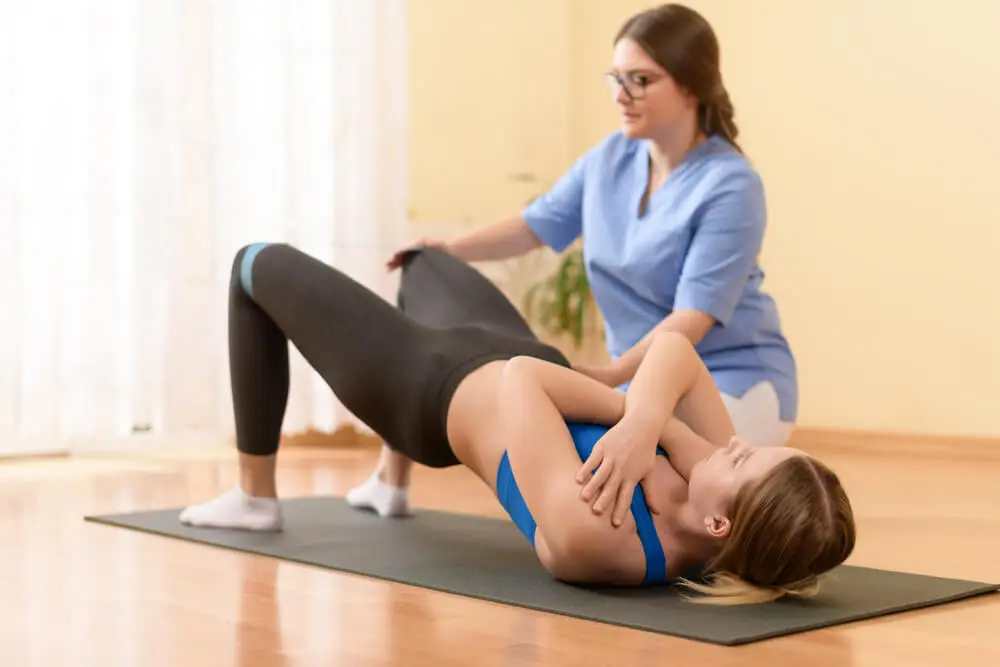
    1. Lying hamstring stretch

    Purpose: This stretch is intended to stretch out the hamstrings, reduce pressure on the SI joints, and decrease back and pelvic pain. 

    How to do the lying hamstring stretch: 

    • Grab a hand or bath towel and lie down on your back on a yoga mat or mattress.
    • Keep your left leg on the floor.
    • Slowly lift your right leg off the floor and wrap the towel around your thigh. 
    • Straighten your right knee until you feel a stretch in the back of your thigh. 
    • Hold this stretch for 10 to 30 seconds. 
    • Slowly lower your right leg back to the ground. 
    • Then, repeat these steps to stretch your left leg. 
    • Continue to repeat the stretch until you’ve done both legs three to five times. 
    1. Quadriceps stretch

    Purpose: Stretching the quadriceps can also help decrease pain in the lower back and pelvis by taking stress off the SI joints.

    How to do the quadriceps stretch:

    • Stand near a counter or wall. 
    • Bend your right leg at the knee and grab your right foot with your right hand. 
    • Gently pull your leg upward behind you until you feel a stretch in the front of your thigh. 
    • Hold this stretch for 20 to 30 seconds.
    • Switch legs and stretch your left quadriceps for 20 to 30 seconds. 
    • Repeat the stretch until you’ve done it for 60 seconds total on both sides. 
    1. Hip abductor stretch

    Purpose: The hip abductor stretch is designed to reduce tension in the hip abductor muscles, which can help decrease back and pelvic pain. 

    How to do the hip abductor stretch: 

    • Sit down on the floor or on a yoga mat.
    • Open your legs so that they form a triangle. 
    • Straighten your legs and point your toes toward the ceiling.
    • Place your hands on the ground between your legs and bend forward from the waist until you feel a stretch in your hips. 
    • Hold this stretch for 10 to 15 seconds. 
    • Repeat the stretch until you’ve completed 60 seconds of stretching in total. 

    Advent PT offers top-notch treatment for back and pelvic pain

    Need help treating back and pelvic pain caused by SI joint dysfunction? Our physical therapists at Advent Physical Therapy can help you find relief from your pain. We’ll start by doing a free screening to confirm that your pain is being caused by SI joint problems. Then, our specialists can construct a unique therapy plan for you that’s designed to reduce your pain. Even better, we can make virtual therapy and/or at-home care appointments a part of your therapy plan, and these services allow you to get treatment for your pain without leaving home. 

    Contact our team today for more information about how we can treat SI joint problems and symptoms or to schedule your initial appointment.

  • Three exercises for treating shoulder and upper arm pain

    Three exercises for treating shoulder and upper arm pain

    The shoulder and upper arm muscles help people perform many normal daily activities. For instance, your biceps help lift your arm to sip your coffee, and your triceps help lower your cup back to the table. 

    Unfortunately, it’s likely that you’ll experience shoulder and upper arm pain at some point in your life, and medical research shows that up to 26% of people have shoulder pain at any given time. In turn, this can make doing everyday tasks much more difficult. By seeking help from a physical therapist, you can successfully address your shoulder and upper arm pain. One way these specialists can help you is by showing you how to do therapeutic exercises such as: 

    1. Shoulder rolls

    Purpose: This exercise is intended to help stretch your shoulder muscles, which can help decrease your shoulder and upper arm pain.

    How to do shoulder rolls:

    • Sit at the front of a stable chair with your back upright and your head centered over your shoulders. 
    • Slowly roll your shoulders forward in a circle until you’ve returned to the starting position. 
    • Repeat this step until you’ve done five to 10 forward rolls. 
    • Then, slowly roll your shoulders backward for another five to 10 reps. 
    • Repeat this exercise as necessary. 
    1. Triceps stretch

    Purpose: The triceps stretch is intended to decrease shoulder and upper arm pain by reducing tension in the triceps muscles. 

    How to do the triceps stretch:

    • Sit on the edge of a stable chair with upright posture. 
    • Lift your right arm so that it’s extending straight up over your head. 
    • Bend your elbow so that your forearm is behind you. 
    • Place your left hand on your right elbow and gently pull your elbow backward until you feel a stretch in the back of your upper arm.
    • Hold this stretch for 10 to 15 seconds. 
    • Relax for a few seconds; then do the stretch on your left arm. 
    • Repeat the stretch until you’ve stretched each tricep for 45 to 60 seconds. 
    1. Standing biceps stretch

    Purpose: This therapeutic exercise is intended to stretch the chest, biceps and shoulders; it can help decrease shoulder and upper arm pain. 

    How to do the standing biceps stretch:

    • Stand up straight with your feet shoulder width apart. 
    • Place both hands at the base of your spine with palms facing backward and fingers interlaced. 
    • Straighten your arms and lift them up as high as you can. 
    • Hold this position for 10 to 15 seconds. 
    • Take a brief break.
    • Repeat the stretch until you’ve done it for 45 to 60 seconds in total. 

    Find top-notch treatment for your shoulder and upper arm pain at SSOR

    Fed up with feeling shoulder and upper arm pain? At SSOR, our physiotherapy team can help you find effective treatment for the pain you’re living with. A free screening by our therapists can pinpoint the cause of your pain, and then we can create a customized physical therapy plan designed to reduce it. 

    Can’t make it into one of our therapy clinics? No worries! Our team offers at-home care and virtual therapy services that allow you to get help right in your own home. 

    Contact us today for more information about all the treatment options we offer for your pain or to schedule your initial appointment. 

  • Four tips for how to sleep with a stiff neck and shoulder

    Four tips for how to sleep with a stiff neck and shoulder

    Nobody is a stranger to a sore or stiff neck or shoulder. Mild soreness and pain is a normal part of life that may occur from overexertion or sitting with poor posture for too long. However, when your neck and shoulders are frequently stiff, it can be hard to get a good night’s sleep. 

    By making some simple adjustments to the way you sleep, you may be able to get a good night’s rest and also help reduce neck and shoulder pain.

    How to sleep with a stiff neck and shoulder

    1. Change your position — Poor sleeping position might not only make it hard to sleep with neck and shoulder pain, it may also be the cause of your pain. Avoid sleeping on your stomach because it forces you to turn your head for hours at a time, which strains your neck and shoulders.

      Instead, sleep on your back or on your side. Make sure your spine is aligned and supported to help reduce and prevent a stiff neck and shoulder.

    2. Use a better pillow — A pillow that is too flat or too big will cause your neck to be out of alignment while sleeping. You’ll wake up with a stiff neck and shoulder on a regular basis.

      Find a pillow that provides the right amount of support you need to keep your neck aligned with your spine.

    3. Stretch and exercise — Stretching and exercising on a regular basis can help keep your muscles strong and flexible to help prevent stiffness. Stretching before going to bed and when waking up can help reduce stiffness in the neck and shoulder when sleeping.
    4. Visit a physical therapist — Your stiffness may be connected to an injury or a chronic medical condition that requires professional treatment. Physical therapists can examine your neck and shoulders to identify the cause of your pain and stiffness. They can guide you through a personalized treatment routine to help you manage your pain, improve your range of motion and perform simple tasks, such as getting a good night’s sleep.

    Visit Panther Physical Therapy for stiff neck and shoulder pain treatment

    Do you have trouble sleeping due to a stiff neck and shoulder? Physical therapy can help reduce shoulder and neck pain, so you can enjoy more of your favorite activities and get a better night’s sleep. Our team at Panther Physical Therapy can examine your neck and shoulder and work on a treatment that can help you reduce your pain and stiffness, especially while sleeping. Contact our team for more information about how to sleep with a stiff neck and shoulder or to schedule an initial appointment.

  • How common is hip pain during pregnancy?

    [et_pb_section fb_built=”1″ admin_label=”section” _builder_version=”3.22″ global_colors_info=”{}”][et_pb_row admin_label=”row” _builder_version=”3.25″ background_size=”initial” background_position=”top_left” background_repeat=”repeat” global_colors_info=”{}”][et_pb_column type=”4_4″ _builder_version=”3.25″ custom_padding=”|||” global_colors_info=”{}” custom_padding__hover=”|||”][et_pb_text admin_label=”Text” _builder_version=”3.27.4″ background_size=”initial” background_position=”top_left” background_repeat=”repeat” global_colors_info=”{}”]Hip pain is a very common issue during pregnancy. In fact, it’s reported that about 1 out of 3 three pregnant women will develop hip pain. 

    The hips are large, complex joints, and the added weight of pregnancy can lead to more stress on your hips and pain. However, additional body weight isn’t the only reason pregnant women develop hip discomfort. A physical therapist can help you learn the specific source of your pain, and they can also provide effective treatment options for hip pain during pregnancy. 

    Common causes of hip pain during pregnancy

    You’re less likely to develop hip pain at the beginning of your pregnancy. Most women who develop pain in this joint don’t do so until their second or third trimester. There are many issues that can lead to hip discomfort besides the added weight that pregnancy causes. A few other common causes of pregnancy-related hip pain include: 

    How physical therapists can treat your hip pain during pregnancy

    Your physical therapist can do a lot to reduce your hip pain, and they will start by evaluating you. This evaluation allows your therapist to gather information about your condition and symptoms. In turn, the information they gather can help them diagnose the precise cause(s) of your hip pain. 

    Once they’ve figured out the source of your pain, your physical therapist will build you a unique therapy plan. Such a plan can make use of therapy methods like: 

    Armor Physical Therapy offers treatment for hip pain during pregnancy

    Have your hips become increasingly painful as your pregnancy has progressed? Our physical therapists at Armor PT can help you find ways to ease your pain. We offer free screenings that can reveal the source of your pain and jump-start your therapy process. In addition, our team excels at creating personalized treatment plans designed to decrease hip pain and prevent it from returning. 

    Having trouble getting around because of your pain? Our physical therapists can help you right in your own home thanks to our at-home care and virtual therapy services, and we can start helping you even if you don’t have a doctor’s referral. 

    Contact us today for more information about all our hip pain treatment options or to schedule an initial appointment. [/et_pb_text][/et_pb_column][/et_pb_row][/et_pb_section]

When Was Your Appointment?

We recently changed bill pay providers. Please click the button for the date of your appointment to be directed to the correct online payment portal.