Please ensure Javascript is enabled for purposes of website accessibility

Category: Elbow Pain

  • 5 types of PT treatment that may improve your elbow bursitis

    5 types of PT treatment that may improve your elbow bursitis

    Thin, fluid-filled sacs called bursae are located throughout the human body. These sacs contain a small amount of lubricating fluid that helps cushion the area between the bones and soft tissue such as the skin. When a bursa in the elbow gets inflamed, it’s called elbow bursitis. 

    You can experience bursitis in many areas of your body. In fact, each year, around 1 in 10,000 people get bursitis in their knees or elbows alone. Elbow bursitis can cause pain and swelling in the tip of your elbow specifically, making it difficult to put pressure on your elbow or complete daily tasks such as washing dishes or typing. 

    Physical therapy treatments for elbow bursitis

    Physical therapy can decrease inflammation in your elbow and help get your elbow bursitis under control. The first thing your physical therapist will do is evaluate your condition. Depending on your pain level and physical limitations, they may suggest certain activities or movements to avoid. This can give your elbow a rest and help you not aggravate the inflamed bursa even more. Once your physical therapist knows what your limitations are, they can design a specialized treatment program for you. Here are some of the physical therapy methods they may use:

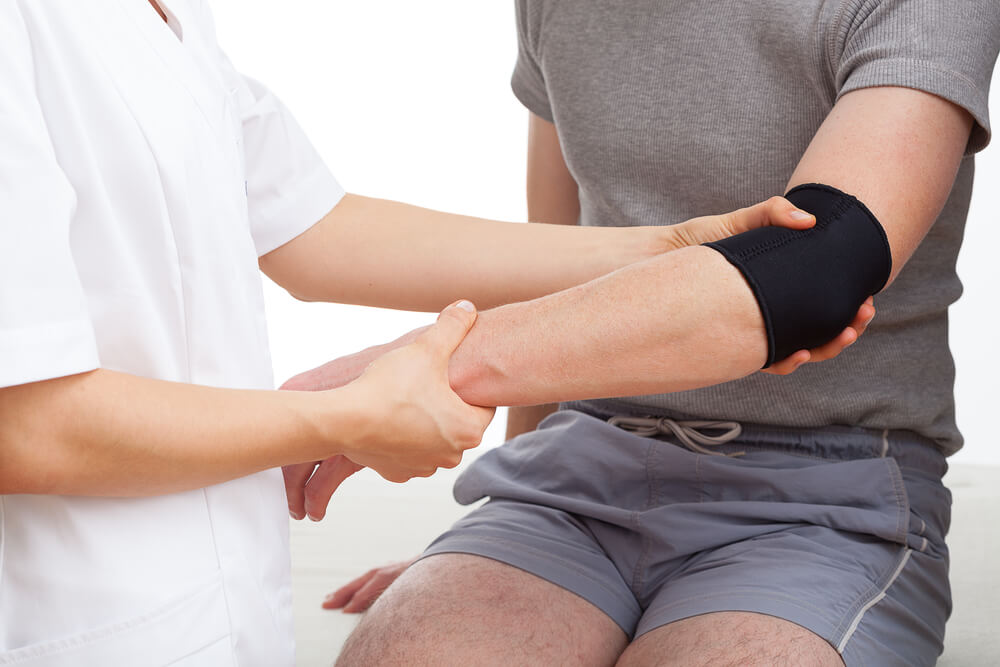
    • Manual therapy — Manual therapy is a hands-on physical therapy method. Using their hands, your physical therapist will carefully move and stretch your arm and elbow. This method of manual therapy is intended to stretch and manipulate your joints and muscles to release tension and increase mobility. With elbow bursitis, you may struggle to move the joint correctly or put pressure on it without pain. Manual therapy is a way your physical therapist can help you move and stretch to regain some of that range of motion.
    • Aquatic therapy — Also known as hydrotherapy or aquatic rehabilitation, aquatic therapy can help you strengthen your muscles and reduce pain from elbow bursitis. Water provides buoyancy and resistance, which can make it easier to exercise without putting unnecessary pressure on your affected joints. 
    • Therapeutic exercise — After an injury, you will naturally avoid using the affected joints and muscles in order to protect them. However, disuse can weaken those muscles and make it easier for you to reinjure yourself. Targeted therapeutic exercises can help you not only regain strength in your elbow and arm, but also achieve better:
    • Stability
    • Balance
    • Endurance
    • Flexibility

    Once your physical therapist evaluates your injury, they’ll show you how to do specific exercises that can help you regain your mobility and strength without reinjuring yourself. Therapeutic exercises are typically used as one part of a larger physical therapy treatment plan.

    • Electrical stimulation — Electrical stimulation is a type of physical therapy that aims to stimulate nerves and help with pain, flexibility and range of motion in the elbow and arm. When using electrical stimulation, your physical therapist will place self-adhesive electrodes around the injured area. These electrodes allow electricity to pass through the affected tissue, which can disrupt pain sensors and bring you relief. It may also help with swelling and range of motion in your elbow. There are different kinds of electrical stimulation, so your physical therapist may choose a specific kind depending on your condition.
    • Instrument-assisted soft tissue mobilization — Instrument-assisted soft tissue mobilization (IASTM) is a form of therapy where your physical therapist will use instruments to help stretch and mobilize the affected area. Methods such as the Graston Technique® may help with loss of motion or function due to injuries or conditions such as bursitis.

    As your elbow begins to heal, your physical therapist may allow you to resume certain activities or include new physical therapy exercises in your treatment plan. These must be added slowly and shouldn’t cause you additional pain.

    Symptoms of elbow bursitis

    There are many conditions that can affect your elbow joint, so how do you know if it’s elbow bursitis specifically? Here are a few symptoms of elbow bursitis that may confirm whether that’s what you’re dealing with:

    • Swelling — This is the first symptom many people notice. It can be difficult to see swelling right away in the elbow since the skin is loose around the joint. However, swelling can flare up quickly and make the elbow joint look bigger even when the arm is straight. As the swelling increases, it may begin to look as though you have a golf ball under the skin at the tip of your elbow.
    • Pain — Pain in and around the elbow is a common symptom of elbow bursitis. This pain most often occurs if you place direct pressure on the injured elbow, such as leaning on your elbow or resting it on a hard surface. Sometimes, pain can occur while bending the elbow. People with elbow bursitis usually don’t feel pain while straightening the elbow. While pain is a common symptom, not everyone experiences significant pain.
    • Redness and warmth — Sometimes, the affected bursa can become infected. When that happens, you may experience redness and warmth at the tip of your elbow. A thick, cloudy, yellow or white fluid (pus) may also drain from an infected bursa, and you can also develop a fever if the infection is severe. If you think the bursa in your elbow is infected, call your doctor immediately.
    • Tenderness — Another symptom of elbow bursitis is sensitivity in and around the elbow. Even gentle pressure on or near the point of the elbow may be painful if the bursa is inflamed.

    There can be similarity between elbow bursitis and other conditions that affect the same area, such as tendinitis. However, tendinitis is caused by inflammation in the tendons in the arm, while bursitis is caused by inflammation of the bursae. If your pain is more concentrated around the elbow directly, it’s more likely to be bursitis. If the pain shoots down your arm, it may be tendinitis.

    At-home treatments for elbow bursitis

    In cases of mild elbow bursitis without infection, you may be able to heal it with rest and by avoiding activities that may aggravate the elbow. Using a compression wrap or sleeve and icing your elbow for 15-20 minutes two to three times a day may help decrease swelling. Additionally, a small pad or cushion on the elbow can help you avoid putting pressure on your injury. Over-the-counter anti-inflammatory medication, such as ibuprofen or naproxen, can help ease inflammation and swelling in the elbow joint. 

    If these at-home methods don’t provide relief, physical therapy or draining the fluid from the inflamed bursa may be the next step. If the bursa is infected, you may need antibiotics or surgery. See your doctor right away if you think your bursa may be infected.

    Getting control of your elbow bursitis

    Elbow bursitis can interfere with your life in many different ways, but it doesn’t have to stop you from doing what you love. With the right treatment methods, you can get back to an active life doing your favorite sports and hobbies. 

    The sooner you begin treatment for your elbow bursitis, the sooner you can get relief. Our licensed physical therapists at Peak Performance are highly trained in the best methods for treating elbow pain and helping you get your mobility back. If you’re ready to take control of your elbow bursitis, call us or request an appointment today. 

  • 4 exercises to heal or prevent tennis elbow

    Feeling pain in your elbow, wrist and hand? The cause could be tennis elbow. Tennis elbow, sometimes referred to as lateral epicondylitis, is swelling in certain tendons that run through your elbow and forearm. These tendons function to help your wrist bend backward. When these tendons become inflamed, regular wrist and elbow movements can become more difficult and painful. One of the most common symptoms is persistent pain around the outside of the elbow. Some people also experience pain in the forearm and wrist. The condition is called tennis elbow because it is typically associated with the kind of repetitive wrist and elbow movements that are common when playing tennis. However, you don’t have to be a tennis player to develop tennis elbow. Repeated stress and overuse of the elbow and wrist tendons in any activity can increase the risk of tennis elbow.

    If you are experiencing pain, swelling and tenderness from tennis elbow, it is important to seek treatment. Physical therapy can be an excellent way to start your healing journey. When addressing tennis elbow, one of the most beneficial PT treatments is exercise. After assessing your condition, your physical therapist will create an exercise plan that meets your needs. Learning about some of the exercises that are often used to heal and prevent tennis elbow can help you prepare for treatment.

    Key exercises for preventing and healing tennis elbow

    • Wrist flexor and extensor stretches — Though the condition is called tennis elbow, it has a major effect on the wrist as well as the elbow. With the right wrist stretches, you can start alleviating pain and stiffness. Stretches can also promote circulation, accelerating your body’s natural healing processes. To do wrist flexor stretches, extend the affected arm out in front of you. With your other hand, grasp the fingers of the affected hand and gently pull them so that your palm faces outward. You should feel a stretch from your wrist into your forearm. Try to hold the stretch for up to 30 seconds; then release and repeat. The ideal number of repetitions will depend on your condition. Your physical therapist can offer personalized guidance on each exercise. 

    Wrist extensor stretches are similar to flexor stretches, but they work out a different set of tendons. Instead of pulling your fingers with your palm facing outward, extensor stretches involve your palm facing toward you. By doing flexor and extensor stretches, you can help relieve tension and swelling in your wrist tendons.

    • Pronation and supination — With your palm facing down, hold a light weight in your hand. Rotate your forearm outward until you feel a stretch. Then reverse direction, rotating your arm inward. These motions are called pronation and supination. The upward movement is supination and the downward movement is pronation. This rotation exercise is a great stretch for your forearm, which is one of the main areas affected by tennis elbow. In addition to providing relief from your symptoms, stretching the forearm can also help reduce the risk of tennis elbow recurring in the future.
    • Wrist extension and flexion — With your palm facing down, hold a light weight in your hand. Lift your wrist up slowly and slowly back down. This will strengthen your forearm extensor muscles. Then, with your palm facing up, hold a light weight in your hand. Lift your wrist up toward you, curling in and slowly back down. This will strengthen your wrist flexors. 
    • Finger stretches — Your finger motions are directly facilitated by moving parts in the wrist. By stretching your fingers, you can also exercise your wrist. One of the best exercises for this involves putting a rubber band around all the fingers on one hand. Try to move your fingers apart from each other so that the band stretches into a larger circle. You should feel the stretch in your fingers as well as your wrist.

    What upper body exercises can you do with tennis elbow?

    Tennis elbow can limit your ability to perform certain upper body exercises. Some upper body exercises can actually worsen your condition. Fortunately, there are also plenty of safe alternatives. Here are some upper body exercises that are generally safe for people with tennis elbow:

    • Biceps curls — When doing biceps curls with tennis elbow, it is important to maintain a neutral grip. This means your palms should be facing each other. A neutral grip can help you avoid putting unnecessary stress on your wrists. With a dumbbell in each hand, slowly curl the weights toward your shoulders. Try to keep your elbows close to your sides throughout the motion. After raising the weights, lower them back down in a slow, controlled movement. Biceps curls with a neutral grip can be a great way to build shoulder and upper arm strength without increasing the risk of further injury.
    • Triceps kickbacks — Triceps kickbacks are another dumbbell exercise that can usually be performed by people with tennis elbow. Like any exercise, though, it can help to check with your physical therapist beforehand to ensure that it is safe for you. To do triceps kickbacks, hold a dumbbell in one hand and bend your upper body forward at the hips. Keeping your back straight, bend your elbow at a 90-degree angle and move your weight-bearing arm back until the dumbbell is at your hip. Then extend the arm, straightening it behind you. You should feel this motion engage your triceps, which are the muscles along the back of your upper arm. You can repeat this exercise with each arm. 
    • Modified lat pulldowns — The latissimus dorsi muscles, often simply called the lats, are large, flat muscles in the back. Lat pulldowns work out these muscles, which can be great for building upper body strength. However, regular lat pulldowns can hinder progress with tennis elbow recovery. To get a similar workout without hurting your elbow, you should modify your lat pulldowns. One popular alternative to using a standard pulldown machine involves using a resistance band instead. Using a resistance band, you can get the same pulling-down motion without bending your elbow as much. This can prevent further injury and even reduce tension in the elbow.

    Address your tennis elbow with SSOR

    SSOR (Specialists in Sports and Orthopedic Rehabilitation) offers top-notch treatment for tennis elbow. In addition to a tailored exercise plan, we can work with you to provide a range of other evidence-backed PT treatments. With our help, you can experience relief from your symptoms and work to prevent more overuse injuries in the future.

    Call us or request an appointment today to get professional treatment for your tennis elbow. 

  • Why does my elbow hurt when I extend it?

    Why does my elbow hurt when I extend it?

    Your elbow is a joint that’s essential to many movements that you complete throughout the day, from reaching up to grab something from a shelf to opening a door. So when you feel an ache when you try to extend your elbow, it can interfere with your ability to carry out your daily responsibilities. 

    There are a variety of reasons that your elbow is hurting when you extend it, such as an injury or a medical condition. While it may be tempting to grin and bear elbow pain in hopes that it goes away on its own, it’s important to learn about the possible cause for the ache. Then you can make sure that it’s properly treated.

    We’ll talk about possible reasons that your elbow hurts when you extend it as well as treatment options that you can explore with physical therapy. 

    Potential reasons that your elbow hurts when you extend it

    Your elbow is a hinge joint that connects the forearm to the upper arm. Since it gets put through a lot on a daily basis, it’s not uncommon to feel elbow pain every now and then. If you lean on your elbows for an extended period of time or try a new sport that requires repetitive arm movements, it’s possible to feel temporary elbow pain.

    If your elbow constantly hurts when you straighten it, it’s possible that you’re experiencing an injury or a medical condition that requires further treatment. Sports injuries and repetitive strain injuries are both common sources of elbow pain.

    Here are some potential reasons that your elbow hurts when you extend it:

    • Tennis elbow — Lateral epicondylitis, commonly known as tennis elbow, refers to irritation of the tendons and muscles of the elbow from overuse. It’s caused by repetitive wrist and arm movements. The main symptom is pain on the outside of the elbow that can make it difficult to extend your arm. 
    • Golfer’s elbow — Medial epicondylitis, commonly referred to as golfer’s elbow, is a type of tendinitis that’s caused by excessive or repetitive force during wrist and finger motions. The stress can cause the tendons to become inflamed, resulting in pain both on the inside of the elbow and down the arm.
    • Biceps tendinitis — Another possible type of tendinitis that can affect the elbow stems from the biceps tendon. The tendon connects the inside of the elbow joint to the biceps muscles. It can become inflamed from repetitive arm and shoulder movements or sudden injury. The main symptom is pain from the upper arm down to the elbow.
    • Bursitis — There’s a fluid-filled sac in the elbow, called the olecranon bursa, that protects the tendons from the bones and muscles. The bursa can become inflamed from trauma or prolonged pressure, causing pain and swelling from the additional fluid that builds up inside it.
    • Nerve entrapment — Your ulnar nerve travels from your neck down to your hand to help with movement and sensation. This nerve can become irritated or compressed from repetitive compression or prolonged elbow flexion. This can lead to cubital tunnel syndrome, which causes pain on the inside of the elbow.

    How physical therapy can treat pain while extending your arm

    Not being able to extend your elbow without wincing in pain can interfere with your overall quality of life, which means it’s important to learn about the different treatment options that are available. A physical therapist can use techniques that reduce your pain as well as improve the overall function and mobility of the hinge joint.

    A physical therapist will evaluate your symptoms to determine the cause of your pain before creating a treatment plan that will best fit your needs.

    Some physical therapy treatment options to alleviate elbow pain include:

    • Soft tissue mobilization — A common manual therapy technique for elbow pain is soft tissue mobilization. The physical therapist moves their hands in massage-like motions to feel for scar tissue surrounding the muscles and tendons. Then they gently break it up to release the painful tension.
    • Stretches — If your elbow pain flares up during extension, it’s important to improve the joint’s range of motion. Your physical therapist will show you stretches that will increase the area’s flexibility and overall mobility.
    • Strengthening exercises — It’s important to strengthen the muscles surrounding the elbow joint to keep it stabilized and properly functioning. A physical therapist will walk you through safe and effective exercises that will increase the area’s strength. By strengthening your elbow muscles, you also reduce the risk of future injury.

    Whatcom Physical Therapy can help when you feel elbow pain when you extend it

    While some causes of temporary elbow pain can be brushed off, feeling an ache every time you try to extend it is a call for treatment. A physical therapist can help diagnose the issue, such as tendinitis or bursitis, before utilizing techniques that can decrease the pain and increase the elbow’s overall function.

    Contact our team today for more information or to schedule an initial appointment. 

  • 4 ways to reduce burning pain in your elbow

    When the tendon in your elbow becomes injured or affected by a certain condition, sometimes a burning pain can result in the elbow joint. The most common types of elbow conditions that cause this type of pain are tennis elbow and golfer’s elbow; however, the conditions can vary depending on the tendon that has been injured.

    When the lateral epicondyle tendon becomes inflamed or injured, tennis elbow is the result. Tennis elbow is known for affecting the tendon on the outside of the elbow. Golfer’s elbow affects the medial epicondyle tendon when it becomes inflamed or injured. This tendon is located on the inside of the elbow.

    Research suggests that almost 2% of the population in the United States will experience at least one of the two elbow injuries in their lifetimes. Are you one of the many in the U.S. who is struggling to manage their elbow condition? It’s a good idea for you to schedule a visit with a physical therapist. They’ll help you address the source of your burning elbow pain. From there, they’ll treat it at the root, whether it’s tennis or golfer’s elbow, or something else entirely.

    These 4 therapy methods can help treat your burning elbow pain

    Whether you’re feeling a burning pain in your elbow when you go to lift up your morning coffee cup or when you go to turn on the sink faucet before washing dishes, physical therapy is likely to help. There’s no shortage of techniques and treatments that a physical therapist might use to treat your elbow. Depending on the type of elbow condition you’re dealing with, your therapist might use varying techniques. 

    While the techniques below aren’t the only ones your therapist may utilize during treatment, they are a few of the most popular:

    • Myofascial release — Myofascial release is a type of manual therapy therapists use to break up tight muscle and soft tissue bands. It involves a therapist using their hands to manually manipulate the skin, muscles and other soft tissue. Myofascial release can be particularly effective for people struggling with burning pain from tennis elbow. A study on myofascial release revealed that the technique helped patients reduce their tennis-elbow related pain by almost five points in a time period of under five weeks.

    • Instrument-assisted soft tissue mobilization (IASTM) — IASTM is another treatment method that involves the manipulation of the soft tissue, but with instruments rather than hands. It’s intended to reduce scar tissue formation. This technique is stronger than manual therapy, and can reach further into the soft tissue than myofascial release. Breaking up tension and scar tissue throughout the body with an instrument can help alleviate some of the burning pain that you’re experiencing in your elbow. One study found that IASTM helped 78% of its participants resolve their tennis elbow pain within an eight-week time period.

    • Therapeutic exercises — Therapeutic exercises can benefit patients with burning pain in their elbows, whether it be due to tennis or golfer’s elbow. Eccentric movement is one type of exercise that can improve strength and reduce pain and tension in the soft tissue.

    • Make lifestyle and movement changes — Sometimes it’s our daily movements and activities that lead to elbow pain. When this is the case, physical therapists can help you determine what these activities are and how you can adjust them to avoid causing yourself more elbow pain. 

    Armor Physical Therapy offers top-notch treatment for burning pain in the elbow

    Are you ready to get relief from the burning pain in your elbow that you think may be tennis or golfer’s elbow? Our team of physical therapists at Armor PT can help you start treatment for your injury or condition. We perform free screenings designed to determine the root cause of your pain so that you can get a better idea of where to start with treatment. Once you’ve undergone a screening and we know what the source of your pain is, we can create a personalized treatment plan that will help you manage your pain and reduce the chances of it showing up again.

    If getting to and from your therapy sessions with burning elbow pain is your main concern, you don’t need to worry any longer. Our physical therapy team offers virtual physical therapy services to treat you at home.

    Contact us today for more information about how we can treat your burning elbow pain or to schedule an initial appointment with us.

  • Physical therapy for tennis elbow

    Physical therapy for tennis elbow

    Millions of people play tennis, either on the weekends with friends or at a professional level. And while tennis can be fun, it can take a toll on the body. In fact, there’s an elbow injury that’s so common with tennis players that it was nicknamed after the sport. 

    Tennis elbow is common across the globe, affecting about 2% of the population. The good news is that there are several physical therapy exercises and techniques that can alleviate the painful symptoms. That’s what we’re here to teach you about.

    Read on to learn about the basics of tennis elbow and how physical therapy can help reduce the pain so that you can get back to your daily activities (or back on the court).

    What is tennis elbow?

    Lateral epicondylitis, often referred to as tennis elbow, is the irritation of the tissue that connects your elbow to the forearm muscle. The condition can be either inflammation or a microtear in the tendons. It’s classified as a repetitive strain injury, or an RSI, as it’s often caused by repeated arm and wrist movements.

    It can be caused by short-term overuse, such as heavy lifting, which means putting excessive strain on the forearm muscles that have been otherwise underutilized and overwhelming the tendons.

    It’s important to note that despite the nickname, tennis elbow can affect anyone, not just athletes. Since the injury comes from repetitive motions, it can affect people who have jobs that require completing the same movements over and over, such as:

    • Carpenters.
    • Plumbers.
    • Painters.
    • Butchers.
    • Musicians.
    • Desk workers who type for extended periods of time.

    Symptoms of tennis elbow

    Pain is the most prevalent sign of tennis elbow and stems from the tendons that attach the outside of the elbow to the forearm muscles. The affected tendons help control your wrist movements, which means the RSI can result in wrist pain, though it may affect your entire arm.

    Symptoms of tennis elbow include:

    Physical therapy for tennis elbow

    Elbow pain is a common reason that people seek physical therapy. If you’re looking to alleviate your painful tennis elbow symptoms, then physical therapy is a treatment option that you should explore. Not only can it help manage the pain, but it can also increase your muscle strength, flexibility and mobility that may be affected by the RSI. 

    A physical therapist can help your tennis elbow with a variety of exercises and modalities. They can determine the best treatment plan based on the severity of your symptoms.

    Three physical therapy techniques for tennis elbow are:

    • Ice treatment — Applying ice to an injury is often one of the first treatment options that health care professionals recommend. Ice numbs the area and decreases blood circulation to decrease your pain and potential swelling. 


    • Joint mobilization — Your elbow is a large hinge joint, so an effective way to treat an injury like tennis elbow is by manipulating the joint to help alleviate pain and increase mobility. Joint mobilization is a common manual therapy technique that involves the physical therapist using their hands to maneuver the joint around until they find the restrictive tissue. Once it’s found, the therapist is able to break up the tissue to release the painful tension and help restore your joint’s range of motion.


    • Targeted exercises — One of the most effective ways that physical therapy helps alleviate tennis elbow symptoms is through specific exercises. A therapist will walk you through exercises that will strengthen your forearm muscles and help you restore their function. They will also show you stretching exercises to increase the range of motion and flexibility in your tendons as well as decrease the risk of future injury. 

    Advent PT can provide physical therapy for tennis elbow

    Tennis elbow can interfere with your quality of life by making it difficult to do simple tasks such as holding a pen or extending your arms to reach something on a high shelf. But physical therapy can help your tennis elbow by not only alleviating the painful symptoms but restoring your arm’s mobility so that you can get back to your daily routine. And that’s where we come in.

    Contact our team today for more information or to schedule an initial appointment.

  • Elbow hyperextension injury: 9 signs and treatments

    Elbow hyperextension injury: 9 signs and treatments

    [et_pb_section admin_label=”section”]
    [et_pb_row admin_label=”row”]
    [et_pb_column type=”4_4″][et_pb_text admin_label=”Text”]The elbow is a hinge joint made up of the humerus, ulna, radius, muscles, tendons and ligaments. It is designed to only bend back so far. If you experience your elbow bending further back than it should, this is called an elbow hyperextension. Anyone can experience a hyperextended elbow, but some are more likely to experience it than others. 

    What causes an elbow hyperextension injury?

    Hyperextension injuries occur when the elbow joint is bent back further than the range of motion naturally occurs. This can occur due to a sporting accident such as football, boxing, tennis or gymnastics. It can also happen due to falling and landing with your arms outstretched in front of you, causing your arms to take the brunt of the fall. Elbow hyperextension injuries can also occur during weight-bearing activities such as yoga or weightlifting. 

    Toddlers can also be susceptible to hyperextended elbows due to their joints and bones not being fully developed. 

    9 symptoms of a hyperextended elbow injury

    When a hyperextended elbow injury occurs, it can cause damage to the elbow joint. It also can cause noticeable symptoms including:

    • A popping sound when extending your elbow.
    • Dull to sharp pain when extending your elbow.
    • Pain when your elbow is touched.
    • Swelling in your elbow joint.
    • Stiffness in your elbow and arm.
    • Weakness in your arm and elbow.
    • Spasming biceps when you extend your arm. 
    • Red or blotchy skin around your elbow.
    • Numbness in your arm.

    If you see any visible deformities, you can’t straighten your arm, or you have bone sticking through your skin, you should seek immediate medical assistance.

    How is an elbow hyperextension injury diagnosed?

    Your doctor may call for an X-ray, an MRI or CT scan imaging to be completed to have a better look of the elbow joint. These tests will be able to detect any possible fractures or tissue damage. Once your doctor knows the extent of the damage incurred, they will be able to prescribe treatment for your hyperextended elbow injury. 

    Treatments for a hyperextended elbow injury

    Depending on the severity of your hyperextension, you may be able to manage your recovery at home. Your doctor may prescribe one or a combination of treatments such as:

    • Cold therapy — Using an ice pack or bag of frozen vegetables in a cloth, place it on the affected elbow for 10 to 20 minutes at a time. Repeat this every few hours for a few days after your injury. It is important to be awake for cold therapy and never put ice directly on your skin. 
    • Medications — Taking an OTC pain medication such as acetaminophen or ibuprofen can help reduce inflammation and pain. 
    • Compression — Using an elastic bandage around your hyperextended elbow may help prevent and relieve swelling in the joint. Wrap the joint firmly but not too tightly. 
    • Brace – Your doctor may put you in a brace to prevent further damage and allow your elbow time to heal properly. All guidance should be properly followed.
    • Rest — Allow your elbow the chance to heal. Ease back into normal activities once cleared by your doctor or physical therapist.
    • Surgery — If the damage is extensive enough, you may have to have surgery to repair your elbow. 
    • Physical therapy — Once your hyperextended elbow has had a chance to heal, your doctor may recommend you do physical therapy to help regain your range of motion and strength 

    Physical therapy stretches that can help your hyperextended elbow injury

    Physical therapy is often an effective option for treating a hyperextended elbow injury or for rehabilitation after more involved medical care. Your physical therapist will teach you stretches that can help alleviate pain and allow you to regain strength and stability in your elbow. They may ask you to continue to do certain exercises at home to boost your recovery. It is important to follow any directions your physical therapist gives you. Notify them if you experience any changes in pain or range of motion either during your office visits or while completing exercises at home on your own. Exercises you may be asked to do include:

    • Wrist flexion stretch.
    • Wrist extension stretch.
    • Static biceps contraction.
    • Static triceps contraction.
    • Resisted forearm supination and pronation.

    Continuum Wellness is here to help you with your hyperextended elbow injury

    At Continuum Wellness, we are confident our team of expert physical therapists can provide you with the best care to help relieve your pain from your hyperextended elbow. Our physical therapists will design a plan customized for you to help improve your life. You shouldn’t suffer any pain longer than necessary.

    Contact our team today for more information or to schedule an initial appointment.[/et_pb_text][/et_pb_column]
    [/et_pb_row]
    [/et_pb_section]

  • Elbow bone spurs: Causes, symptoms and treatment options

    Elbow bone spurs: Causes, symptoms and treatment options

    Bone spurs can pop up where you don’t expect them. Once they appear, they can lead to uncomfortable symptoms like pain, stiffness, tingling and weakness. If you’re feeling any of these in your arm, you may have an elbow bone spur. Getting elbow relief can be complicated, but elbow bone spurs do have treatment options available.

    Bone spurs, sometimes called osteophytes, are growths that develop on the bones in your body. The growths look and feel like bone because they are mainly made up of calcium. Though they can show up on most bones in your body, bone spurs are most commonly found in the joints like the elbow.

    Elbow bone spur causes

    Bone spurs can have many causes. In general, preexisting conditions and joint wear tend to make bone spurs more likely.

    • Joint wear — Over time, use of a joint can lead to wear and tear on the bones and cartilage. This damage can cause bone spurs. This wearing process happens with age, which is one reason why bone spurs are more common in people older than 60.
    • Osteoarthritis — Arthritis is inflammation in the joints, with several diseases and conditions falling under the term. The most common form is osteoarthritis. Osteoarthritis is a degenerative condition that causes cartilage to break down. This can lead to changes in the bone, which can cause bone spurs.
    • Trauma — Bone spurs can be caused by gradual wear, but they can also be caused by singular traumatic events or injuries. If you fall and damage your elbow, the stress on the joint may cause an elbow bone spur to form.
    • Inflammatory conditions — Inflammatory conditions besides osteoarthritis can cause bone spurs to develop in the joints. One such condition is rheumatoid arthritis, an autoimmune disease that causes joint inflammation. Because bone spur growth is linked to joint inflammation, these conditions can make patients more susceptible to bone spurs in the future.

    Elbow bone spur symptoms

    If you are experiencing discomfort in your elbow, how can you tell if it may be a bone spur instead of something else? First, you can check to see if any of the bone spur causes fit your situation. If you have arthritis or have recently injured your elbow, you may be more likely to develop bone spurs. In addition to this, you can see if your symptoms match with patients who suffer from bone spurs:

    • Pain — The most common symptom of bone spurs is joint pain. This pain can range from mild to severe, depending on the size and location of your bone spurs. Large bone spurs can press hard on your nerves and muscles, causing serious pain.
    • Stiffness — As bone spurs grow, they can limit your range of motion. You may feel the affected joint get stiff, and moving your arm can get more difficult. With elbow bone spurs, you may have trouble extending your arm into a straight line.
    • Tingling — Bone spurs sometimes cause nerve compression or pinching. When this happens, you may experience a tingling sensation in the joint. Nerve compression can also lead to a feeling of numbness.
    • Weakness — When bone spurs are severe enough, they can cause weakness in your joints. An elbow bone spur may damage or block the joint so much that the joint feels too weak to bend. Joint weakness can make daily activities tough to accomplish. 

    Elbow bone spur treatment options

    Bone spurs can be a serious ailment, leading to severe pain and immobility if left untreated. With proper treatment, though, it is possible to manage the symptoms and improve joint function. Treatment options for bone spurs include:

    • Medication — Pain medications may be prescribed to help alleviate pain caused by your elbow bone spurs. To minimize the long-term effects of the bone spurs, your doctor may suggest steroid injections. These can reduce inflammation in the target area, alleviating your bone spur symptoms. 
    • Surgery — Before considering surgery, you should consult with a medical professional to make sure it is the best choice for your condition. Arthroscopy, a procedure where bone spurs are removed through small incisions, is usually reserved for cases where the bone spurs actively threaten the patient’s health. In many cases, bone spurs can be managed through noninvasive approaches. 
    • Physical therapy — Physical therapy is a common treatment for elbow bone spurs. The first priority here is to use therapeutic techniques to get rid of the pain as soon as possible. After this, your physical therapy specialist can help you build up strength and flexibility so that you can maintain a pain-free life.

    Find treatment for your elbow bone spurs at Whatcom Physical Therapy

    At Whatcom Physical Therapy, we put your quality of life first. Under the guidance of a professional, you can experience a range of therapeutic techniques designed to improve joint function and reduce symptoms. In addition to strengthening and flexibility exercises, manual therapy and electrical stimulation can be effective in treating bone spurs.

    Contact our team today for more information or to schedule an initial appointment for your bone spur treatment. 

  • What it might mean if you have elbow pain when straightening your arm

    What it might mean if you have elbow pain when straightening your arm

    We use our arms every day for the majority of daily tasks. When you have elbow pain when straightening your arm, it can be difficult to perform routine activities like reaching over your head, carrying grocery bags or putting on clothes. As a result, elbow pain can restrict your activity level and limit your quality of life. If you experience elbow pain when straightening your arm, your pain may also come with the following symptoms: 

    • Stiffness. 
    • Tenderness. 
    • Tingling. 
    • A burning sensation. 
    • Redness or a bump around the joint.

    There are several reasons you may have elbow pain when straightening your arm. Pinpointing the reasons behind your elbow pain can help you find effective treatment for your specific symptoms. Physical therapists can help you identify the cause of your loss of mobility and pain and design a treatment plan accordingly. 

    5 reasons you may have elbow pain when straightening your arm

    If you feel elbow pain when straightening your arm, you could be experiencing signs of a variety of conditions and injuries, ranging from arthritis to tendinitis. Your specific symptoms can help you identify the cause of your pain, which may be any of the following:  

    • Tennis elbow — Tennis elbow refers to the inflammation of the tendon that attaches your elbow bone to the muscles that control your wrist and fingers. Overuse or overexertion of the elbow during physical activities, such as swinging a tennis racket, can irritate this tendon and cause it to become inflamed. The result is a burning sensation and sensitivity when trying to straighten or bend your elbow.

    • Bursitis — Bursitis refers to the inflammation of the bursae, which are tiny sacs of fluid found in your joints. The bursae prevent your tendons from rubbing against your bones and muscles, but overuse and overexertion of your elbow can cause the bursae to become inflamed. This causes swelling and tenderness that can limit your ability to bend or straighten your elbow.

    • Bicep tendinitis — Bicep tendinitis involves the inflammation of your bicep tendon, which connects your bicep muscle to the inside of your elbow joint. Overexerting your elbow by lifting heavy objects can cause irritation to this tendon, which can be felt when trying to straighten or bend your elbow. It’s also possible for this tendon to completely rupture, which may cause intense pain. It can be identified by swelling and bruising where the bicep connects with the elbow.
    • Dislocation — While rare, your elbow pain may be the result of a dislocation. The elbow joint is difficult to dislocate, but it can be possible to dislocate it if you fall on your arm while it’s extended, which can twist and force your elbow out of its place. When this happens, it can be incredibly painful to try to bend or straighten your elbow. You may notice swelling, bruising and a deformed appearance with this injury, so it’s usually clear if a dislocation is the source of your pain.

    • Osteoarthritis — There are several types of arthritis, and osteoarthritis is the most common form that can affect the elbow. This form of arthritis is frequently caused by the natural wearing of cartilage in your joints as you age. With less cartilage, your elbow joint moves with less cushioning between the bones and can become stiff, making it difficult to straighten your arm. Elbow injuries can increase your chances of developing elbow osteoarthritis. Studies show that physical therapy can be effective in reducing osteoarthritis symptoms, including in the elbow.

    How can physical therapy help you straighten your elbow without pain? 

    No matter the cause of your elbow pain, constant elbow pain every time you straighten your arm can be frustrating. Thankfully, physical therapy can help limit your elbow pain and help you get back to the activities you love. During a physical therapy session, your physical therapist may: 

    • Work with your doctor and other medical professionals.

      Physical therapists often communicate directly with your doctor to determine an effective and safe treatment plan. Your doctor may also provide your physical therapist with imaging results, such as from an MRI, to help them better understand your injury and any musculoskeletal concerns they may have.

    • Perform manual therapy techniques like soft tissue mobilization.

      In addition to guiding you through range-of-motion exercises, your physical therapist may use their hands to apply consistent pressure to the tissue surrounding your elbow. Doing so can release tension in your elbow and calm inflammation.

    • Introduce you to at-home exercises.

      Your in-clinic exercises are important during physical therapy sessions, but continuing those exercises at home can help you fast-track your healing process and reduce your pain. Your physical therapist may teach you exercises that you can easily replicate at home. 

    Visit Advent Physical Therapy for elbow pain treatment

    Are you having trouble moving your arm because of elbow pain? Our physical therapists at Advent PT are highly skilled in treatments designed to reduce elbow pain and improve your range of motion, so you can start regaining the use of your arm. 

    Contact our team today for more information about elbow pain treatment or to schedule an initial appointment.

  • Burning pain in the elbow: 7 issues that could be causing it

    Burning pain in the elbow: 7 issues that could be causing it

    Every time you lift your coffee cup to your lips, your elbow moves. However, burning pain in your elbow can make even this easy task much more difficult. Fortunately, a physical therapist can help you find out the source of your pain. 

    Several tendons, nerves and other structures make up your elbow, and issues with any of these structures can lead to elbow pain. Understanding the cause of your pain is one way a physical therapist can assist you. These specialists can also provide effective treatment for the burning pain in your elbow. 

    7 common medical conditions that trigger burning pain in the elbow

    A burning pain in your elbow often means that something is inflamed or irritated. Physical therapists are trained to treat the human musculoskeletal system — this system includes all the structures in your elbow. A few of the most common sources of elbow pain include: 

    • Tennis elbow — To medical professionals, this condition is called lateral epicondylitis. With tennis elbow, the lateral epicondyle tendon on the outside of your elbow is injured or inflamed, causing pain on the outer side of your elbow. 
    • Golfer’s elbow — This issue is also known as medial epicondylitis. Golfer’s elbow happens when your medial epicondyle tendon becomes inflamed or injured. The result is typically pain that’s felt on the inside of the affected elbow. 
    • Olecranon bursitis — The olecranon is the bone that forms the point of your elbow. This bone has a bursa, or a fluid-filled cushion, between it and your skin. When this bursa becomes inflamed, it can lead to swelling and pain at the tip of your elbow. 
    • Rheumatoid arthritis — Rheumatoid arthritis is an inflammatory joint disease that can affect the joints that form the elbow. The immune system attacks its own tissue, which can lead to pain and tissue deterioration over time. This condition is commonly associated with searing elbow pain. 
    • Stress fracture — Stress fractures can occur in the elbow when there has been an overly frequent and/or forceful movement to the area but can also occur when there is weakened bone from osteoporosis. Stress fractures can be painful when they affect the elbow.
    • Nerve entrapment — This condition occurs when the radial nerve, the main nerve in the arm, becomes restricted. The radial nerve can become entrapped when the vertebrae or joints in the elbow pinch it.
    • Ligament sprain — Burning pain can occur in the elbow when there is a ligament sprain. The joints in the elbow are connected together by ligaments, but if one of these ligaments becomes injured or torn, the result is a ligament sprain. 

    Ways physical therapy can help treat the pain in your elbow

    After identifying the source of your elbow pain, physical therapists can help treat it. These specialists can use different therapy techniques to provide a personalized therapy plan for each patient. Some of the therapy methods that may be included in such a plan are: 

    Find treatment for the burning pain in your elbow at Advent PT

    You don’t have to continue suffering from burning pain in your elbow. Our team at Advent Physical Therapy is ready to provide effective treatment for your pain. We can start by doing a free screening on your elbow to pinpoint the cause of your pain. Then, our experienced physical therapists can build you a customized therapy plan intended to: 

    • Reduce pain.
    • Improve joint mobility.
    • Increase ability to do normal daily activities. 
    • Cut risk of future injuries. 

    We can even help treat your pain from home if you sign up for a virtual therapy or at-home care session with us. 

    Contact our team today for more information about how we can treat your elbow pain or to schedule an initial appointment.

  • What should every person know about bone spurs in the elbow?

    What should every person know about bone spurs in the elbow?

    You may have heard that bone spurs don’t commonly form in the elbows, and that may be true for many people. However, there are certain people who are more likely to develop this issue. Baseball pitchers are one example. Another is quarterbacks and other athletes who do a lot of throwing. But really, these bony protrusions can appear in anyone’s elbows and cause them trouble.

    Want to learn even more about bone spurs in the elbow? Physical therapists can help you, and they have laid out some need-to-know information about this condition below. 

    Signs of a bone spur in the elbow

    This elbow condition might affect some people without their being aware of it. However, some of the signs it may cause include:

    • Sharp pain in the elbow.
    • Pain when bending or straightening your arm.
    • Stiffness and weakness in your elbow.
    • A bump that can be felt under the skin of your elbow.
    • Numbness or weakness in the elbow or radiating up or down your arm.
    • Decreased range of motion.

    Common underlying causes of a bone spur in the elbow

    Elbow pain often results from inflammation or injuries. Yet it’s really the issues that inflammation or injuries can trigger that can be the true source of your pain. Bone spurs in the elbow are an example of such an issue.

    Here are some of the underlying issues that can cause these bony protrusions: 

    • Osteoarthritis — Bone spurs are usually a result of wear and tear on the elbow joint, which often comes from repetitive movements or tasks done at home or at work. Osteoarthritis is a condition that involves elbow wear and tear. It occurs when the cartilage and bones in your elbows wear out over time. Bone spurs can result from the body adding additional bone to the area in an attempt to repair the wear and tear of osteoarthritis. 
    • Repetitive, forceful throwing movements — You already read that pitchers, quarterbacks and other people who throw a lot are more likely to develop an elbow bone spur. The reason for this isn’t simply their position title. It’s because they do a lot of forceful throwing movements, and they do them over and over for extended periods. These movements then lead to microtraumas in the elbow bones. The body will try to repair by adding more bone to the area, which can lead to a bone spur. 

    Ways physical therapy can help treat pain from a bone spur in your elbow

    There are many ways a physical therapist can address the symptoms of this elbow issue. Some of the therapy methods they may use can include:

    • Dry needling that can help address myofascial trigger points that are contributing to elbow pain. 

    Find treatment for your elbow condition at Advent PT

    You don’t have to continue suffering from pain because of a bone spur in the elbow. Our team at Advent Physical Therapy is ready to help you find an effective treatment for your pain. We can start by doing a free screening on your elbow to pinpoint the cause of your pain. Then, our experienced physical therapists can build you a customized therapy plan intended to: 

    • Reduce pain.
    • Improve joint mobility.
    • Increase ability to do normal daily activities. 
    • Cut the risk of future injuries. 

    We can even help treat your pain from home if you sign up for a virtual therapy or at-home care session with us. 

    Contact our team today for more information about how we can treat your elbow condition or to schedule an initial appointment.

  • Uncover 3 things PT can do for the bone spur in your elbow

    Uncover 3 things PT can do for the bone spur in your elbow

    What are bone spurs? Bone spurs are bony growths that can occur on the bones that form your body’s joints. While the word “spur” might make it sound like these growths are pointed and sharp, they are actually smooth in many cases. However, that does not mean that they cannot be painful. Bone spurs often grow around the joints, which can cause the affected bone to rub against other bones, muscles, tendons and nerves. This often makes it difficult to move or bend the joint due to pain, stiffness and swelling.

    Bone spurs often occur as a result of overuse or injury. When a bone is injured, the body overcompensates by causing more bone tissue to grow in the affected area. This is why bone spurs often occur in the elbows, hands, spine and other areas that are subject to a lot of movement. If you are experiencing bone spurs in your elbow, you may be finding many tasks to be more difficult. That’s why it’s a good idea to seek help from a physical therapist to treat your elbow bone spur.

    What can physical therapy do to treat bone spurs in my elbow?

    Thankfully, bone spurs are a condition that can be treated with the help of physical therapy. A physical therapist can assist in reducing the pain and swelling caused by the bone spurs in your elbow. They can also help restore your full range of motion that may have become limited due to bone spurs. Here are three ways that physical therapy can treat bone spurs:

    1. Joint mobilization — A physical therapist can mobilize stiff and painful joints using this form of hands-on therapy. Joint mobilization involves your physical therapist moving the affected joints using the skilled application of force and direction to restore movement.
    1. Soft tissue mobilization — This form of manual therapy can help to break up scar tissue that may have formed around your bone spurs. It also increases the circulation to the area. This technique can also restore flexibility and reduce pain in your elbow resulting from bone spurs.
    1. Electrical stimulation — Your physical therapist can use specialized equipment to deliver electrical pulses to your stiff and aching joints. When they do this, it’s called electrical stimulation. This not only helps relieve pain, but it also helps to decrease swelling and increase circulation in the area. It can also treat muscle spasms that you may experience as a result of bone spurs.

    Where can I turn for physical therapy in my area?

    If you are looking for trusted physical therapy in the western Pennsylvania area, look no further than Panther Physical Therapy. With convenient clinics located in Wexford, Harmony and Allison Park, we provide the highest standards of care for our physical therapy patients. Our team of licensed physical therapy specialists are ready and willing to help treat your pain from bone spurs in your elbow.

    Contact our team today for more information or to schedule an initial appointment.

  • How do bone spurs develop in the elbow?

    How do bone spurs develop in the elbow?

    If you have experienced pain and stiffness in your elbow that does not go away within a day or two, it may be possible that you have developed bone spurs. Bone spurs, also known as osteophytes, are small protrusions that extend from your bones. They most often form around the joints where two bones meet. This can cause mild to moderate discomfort, as well as reduced mobility. The knees, hands, spine and elbows are all common areas where bone spurs can occur. Bone spurs are often a symptom of osteoarthritis.

    What causes bone spurs in the elbow to occur?

    • Aging and osteoarthritis — Osteoarthritis is a common condition in adults over the age of 65. When our cartilage is damaged by conditions like osteoarthritis, the body attempts to repair the damage by forcing more bone tissue to grow in the affected joints. This often results in bone spurs.
    • Family history — If your family has a history of developing bone spurs later in life, then the chances are good that you may develop them as well. Bone spurs can often occur due to a genetic predisposition to early degeneration in the joints and bones.
    • Injury and overuse — Bone spurs can occur as a reaction to an injury. The body attempts to repair the damage caused by injury, overuse or poor arm posture by growing more bone tissue.This can result in bone spur growth in the elbow.

    Can physical therapy help with bone spurs in the elbow?

    While most bone spurs are not severe enough to require surgery, they can still cause pain, discomfort and reduced mobility if left untreated. Physical therapy can help make the symptoms of bone spurs in the elbow more manageable, leading to reduced pain and better quality of life.

    Fortunately, Excel Sport & Physical Therapy is here to help. A free consultation with one of our licensed specialists can help us determine the best physical therapy plan for your needs. Our physical therapy specialists employ a variety of methods to manage your symptoms:

    • Stretching exercises to improve mobility.
    • Posture and biomechanics training to prevent further injury.

    Contact our team today for more information on our available treatments, or to schedule an initial appointment. 

When Was Your Appointment?

We recently changed bill pay providers. Please click the button for the date of your appointment to be directed to the correct online payment portal.